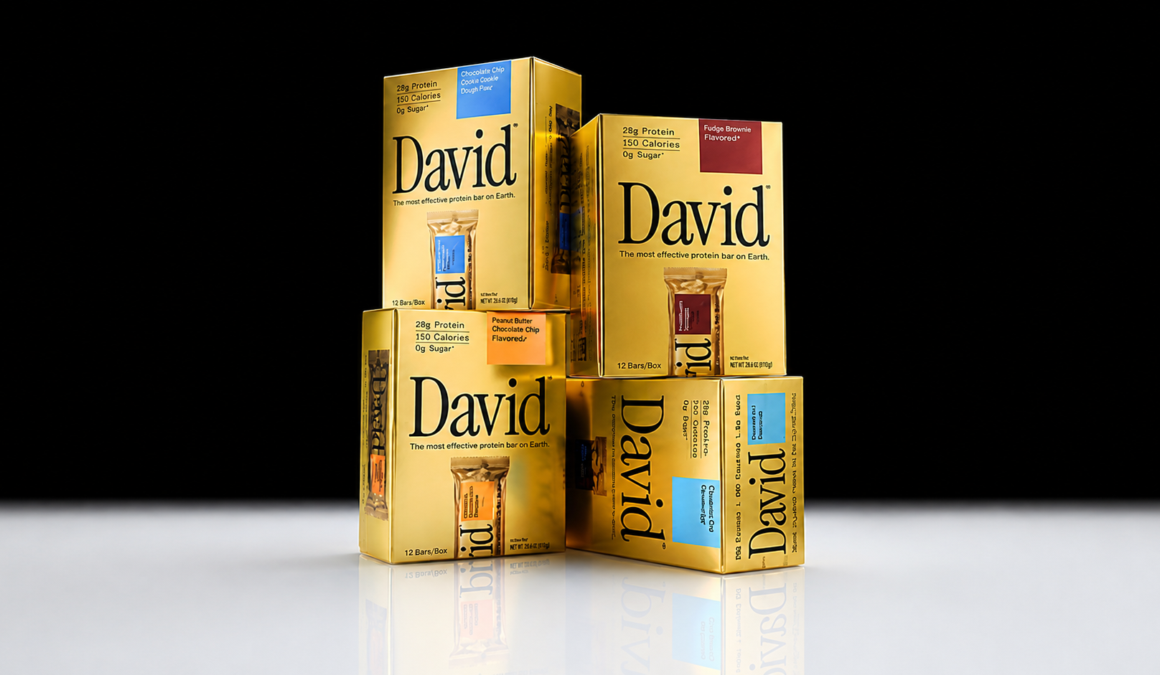
Medici Brands, the parent company of David Protein, raised $250 million in Series B funding on 2 September. The round was co-led by Greenoaks and Valor Equity Partners, both of which invested in David’s $75 million Series A in May 2025. That earlier round coincided with an acquisition that is now the subject of unresolved antitrust litigation.
Medici said the round included participation from ICONIQ, Imaginary Ventures and chief executive Peter Rahal. The company disclosed no valuation. Bloomberg reported on the same day that the round values Medici at $2.25 billion.
David launched direct to consumer in September 2024. It is now in more than 35,000 retail locations including Walmart, Target and Costco. Rahal told AgFunderNews in April that David expects revenue north of $300 million in 2026.
Medici says the money will expand HallPass, its candy brand, extend David into new formats and categories, fund product innovation, and build the infrastructure to launch further brands. A third consumer brand, Rowdy, is due later this year.
Rahal co-founded RXBAR, which Kellogg acquired in 2017 for $600 million.
The ingredient
Medici’s third holding is not a consumer brand. Epogee makes EPG, a patented fat-replacement ingredient. In the words of the federal court now hearing litigation over it, EPG is “produced only by Epogee.”
David acquired Epogee in May 2025, announced alongside its Series A. Trade coverage at the time reported David was taking around 90 percent of Epogee’s output. Rahal later put it higher. “The reality is our David demand, when we did the acquisition, was actually 120% or eventually 150% of Epogee’s capacity,” he told AgFunderNews in April. “Last summer, we had to go out of stock on all items.”
He gave two reasons for buying the supplier. “The acquisition secures supply for us so we can fulfill all the demand for David,” he said in 2025, and second, it “widens the aperture of our vision for where we can innovate and bring great, valuable products to market.”
Since then Medici has expanded beyond David. HallPass launched nationwide at Walmart on 30 August with a 70-calorie candy line.
As patent owners, defendants are free to choose to sell EPG only to non-competitors, or to refuse to sell EPG at all.
The companies that used to buy it
Three food companies that used EPG in their own low-calorie products sued over the acquisition. OWN Your Hunger, Lighten Up Foods and Defiant Foods brought claims against David, Epogee and Rahal personally, alleging monopolisation and refusal to supply under the Sherman and Clayton Acts and New York’s Donnelly Act.
In a September 2025 filing the defendants argued that “as patent owners, defendants are free to choose to sell EPG only to non-competitors, or to refuse to sell EPG at all,” and that the plaintiffs were trying to “dress up as an antitrust monopolization suit what is actually just a case of bad business planning.”
Judge Victor Marrero of the Southern District of New York denied the plaintiffs a temporary restraining order in June 2025. In February 2026 he dismissed their second amended complaint, finding among other deficiencies that they had failed to plausibly define the relevant markets their antitrust claims required. In March he granted them leave to amend again.
On 1 May 2026 David moved to dismiss the third amended complaint, asking the court to do so this time with prejudice. No ruling has been publicly reported.
What Rahal said in April
Six weeks before that motion, Rahal said Epogee’s production had grown. “Now we’ve expanded EPG capacity to the point where we’re really going to go out and look for commercial partners,” he told AgFunderNews. The company had not sold EPG to any third party at that point, but was “working on terms with people.”
Medici’s 2 September announcement does not mention EPG, Epogee’s capacity, or the litigation.
What is not yet known
Whether the antitrust case survives the pending motion. Whether Epogee begins supplying third parties, and on what terms. And how much of the $250 million is directed at the ingredient business rather than the consumer brands, which Medici has not broken out.