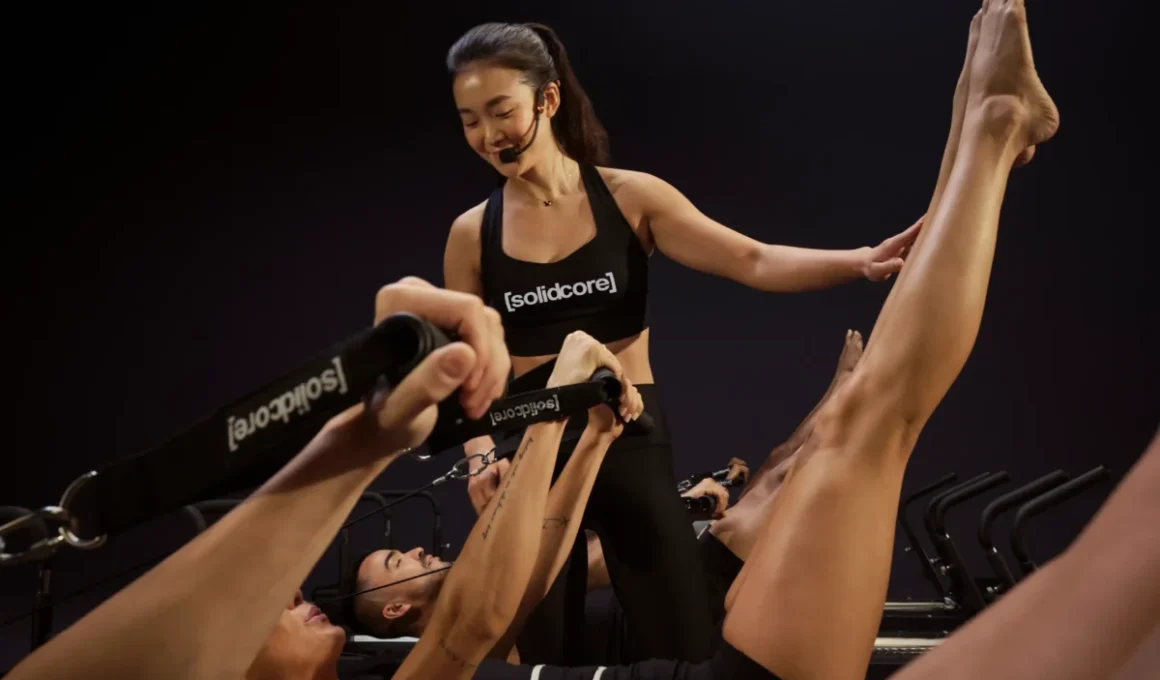
The paragraph at the bottom of a company’s press releases is the most deliberate sentence it publishes. Solidcore’s, from April, reads: “the nation’s leading high-intensity, low-impact strength training brand, offering targeted strength workouts on a custom-built reformer.” Over 165 studios. Founded 2013. The word Pilates does not appear in it.
That absence is not an oversight, and it is not new. The company has been drawing the line in public for more than two years.
Its FAQ page answers the question directly: “No, [solidcore] is not Pilates, but it is a strength-training workout that uses a Pilates-inspired reformer.” A post on the company’s own blog in March 2024 put it more bluntly still, describing the machine as a Pilates-inspired reformer, “but that’s where the similarities end.”
What has changed is the boilerplate. The phrase Pilates-inspired reformer has become a custom-built reformer.
Look at where the word does and does not appear. It is on the FAQ, in the answer to a direct question about whether this is Pilates. It is not on the membership page, which sells “the full-body workout” and “the strongest version of yourself” without using the word once.
Read the class schedule
The clearest evidence is not in the marketing. It is on the timetable.
Solidcore’s class formats are Starter50, Foundation50, Signature50, Power30, Focus50, Advanced50 and Advanced65. The names are built from duration and body part. Not one of them uses the word Pilates.
The beginner class is the tell. In most reformer studios the entry class is named for the method: an introduction to reformer, or to Pilates fundamentals. Solidcore’s is called Starter50: Intro to [solidcore]. The entry point is to the brand, not to a discipline.
In May the company launched a brand platform called Stronger For It. Read alongside the boilerplate and the schedule, the direction has been consistent for two years.
The word appears where the company explains what it is not. It does not appear where the company names what it sells.
Not an isolated case
Life Time, which calls itself the largest provider of traditional Pilates and private sessions in the United States, describes its fastest-growing reformer format, CTR, as an “athletic, 45-minute reformer-based strength training class,” and expects it in more than sixty locations by year’s end. STRONG Pilates rebuilt its schedule into six formats this year; five add strength or cardio work to the reformer, and the sixth is named Pilates Only.
Different companies, different scale, the same underlying move: separating what happens in the room from the word above the door.
The operator move
For three years the word Pilates has been close to free customer acquisition. It is what people search, book and post about, and any format within reach of a reformer could borrow it. Borrowing worked. It also blurred the line between a hundred-year-old method and a strength class that happens to use the same machine.
The operators handing the word back are the ones with enough name recognition to be searched directly. Everyone else is still competing inside a word they do not own, against every other business using it, on price and proximity.
So name the class for what happens in the room. If a member is paying a premium for reformer at your club, be able to say what they are buying beyond the machine: who is teaching it, what that person is qualified in, what gets measured, and what the member can do in twelve weeks that they cannot do now. If the honest answer is the word on the door, that is not a position, it is a rental.
What would your schedule look like if every class had to be named for what it actually delivers?